Below is an excerpt of a research interview: a thesis student (I) talking to a community garden volunteer (P01). The people and the project are invented. The format is what matters.
The transcript
Project: Community gardens and neighborhood trust (MA thesis)
Date of interview: 2026-09-14
Interviewer: Interviewer (I)
Participant: P01, volunteer, community garden
Duration: 00:02:40 (excerpt)
Transcription style: Clean verbatim. Fillers and false starts removed; [inaudible], [laughs] and [crosstalk] marked.
[00:00:04] I: Thanks for making time, and for letting me record. Could you start by telling me how you got involved with the garden?
[00:00:12] P01: Sure. I moved to the neighborhood about three years ago, and I didn't know anyone. There was a flyer at the library about a work morning at the garden, so I went.
[00:00:27] I: And what happened that first morning?
[00:00:30] P01: Someone handed me a pair of gloves and pointed at a pile of compost. [laughs] By the end I had spoken to more neighbors than in my first six months here.
[00:00:48] I: Why do you think that worked?
[00:00:51] P01: Because you're not there to talk. You're there to do something, and the talking happens on the side. It's easier to start a conversation when you're both holding a wheelbarrow.
[00:01:10] I: Has the garden changed how you see the neighborhood?
[00:01:14] P01: Yes. I know whose kids are whose, who has the dog that escapes. Last winter a neighbor [inaudible 00:01:22] when my car wouldn't start, and I wouldn't have asked before.
[00:01:31] I: Were there any tensions, any difficulties?
[00:01:35] P01: Of course. The plot rules caused arguments. Who gets the sunny beds, who waters in August. We had a meeting about it, and honestly people talked over each other. [crosstalk] In the end we made a rota, and it's been fine since.
[00:02:05] I: Would you say the rota helped trust, or just ended the argument?
[00:02:10] P01: Both, I think. Once people saw that the rule applied to everyone, including the people who started the garden, they relaxed.
[00:02:28] I: That's helpful. Is there anything I haven't asked that you'd like to add?
[00:02:33] P01: Only that people think a community garden is about vegetables. It isn't. [laughs] It's about having a reason to stand next to each other.
What each part is for
- Header block. Project, date, who, how long and which style. Months later, or when someone else reads it, this tells them what they are looking at.
- Participant code (P01). Use codes, not names, in the transcript. Keep the list that links codes to people somewhere separate and secure.
- Timestamps. Here one at the start of each turn, in hours:minutes:seconds. They let you return to the exact moment in the audio.
- Speaker labels. Same label, same place, every turn. It makes the file searchable and easy to import for coding.
- Brackets. [laughs], [crosstalk] and [inaudible 00:01:22] are conventions. The time next to [inaudible] says where to listen again. See how to transcribe an interview for the full list.
- Style line. Clean verbatim removes "um" and false starts. Full verbatim keeps them. Name the one you used.
Download
They are plain Word documents with a header table and placeholders in [square brackets]. They open in Google Docs too (File, then Open, then Upload).
Make your own from a recording
- Drop your recording in the box on the homepage. One file up to 30 minutes needs no sign-up.
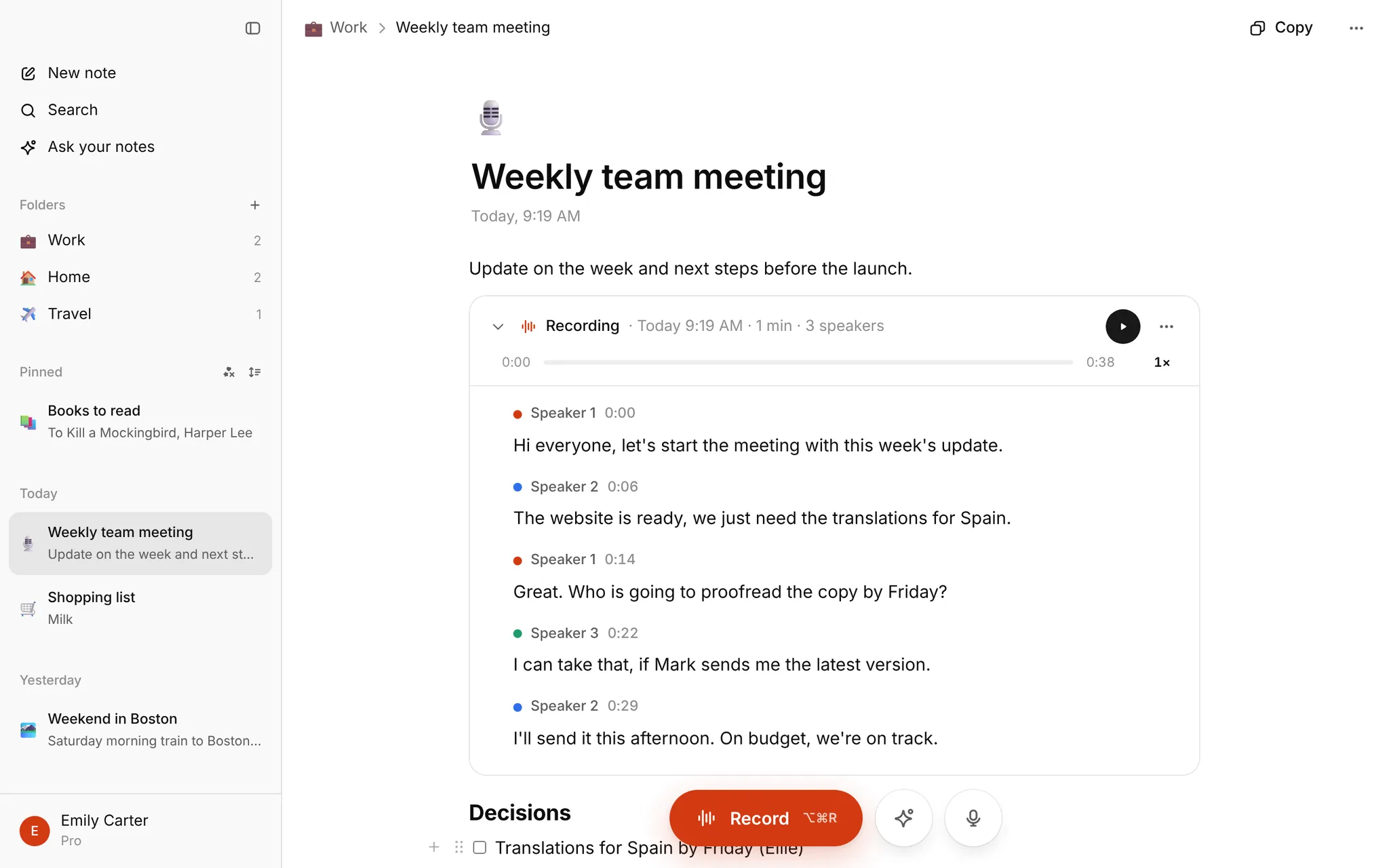
- Copy the transcript. It comes with punctuation, speaker labels (Speaker 1, Speaker 2) and timing.
- Paste it into the template, rename the speakers to your codes by hand, and add the header block.
- Read it against the audio before you quote anything.
There is no Word export yet, and speakers are numbered, not named, so steps 3 and 4 are yours. For longer interviews use My notes, where you can click a sentence to hear it. See interview transcription, and your data, consent and ethics boards if you need ethics approval.